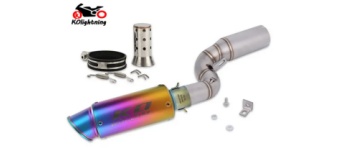
When riders talk about upgrading a motorcycle, the exhaust system is often one of the first components considered—and for good reason. A motorcycle exhaust is far more than a pipe that channels gases away from the engine. It plays a critical role in engine performance, sound control, emissions compliance, durability, and even rider comfort.
In industrial manufacturing and performance riding environments, a high quality motorcycle exhaust must meet demanding technical standards. From material selection and internal structure to precision welding and acoustic tuning, every detail matters. A poorly designed exhaust can limit engine efficiency, increase maintenance costs, or fail prematurely under heat and vibration.
At our company, we work closely with factories, distributors, and professional riders who require exhaust systems that deliver consistent performance, reliability, and value over time. In this article, we break down what truly defines a high quality motorcycle exhaust—beyond appearance or brand name—so buyers can make informed, long-term decisions.
1. The Core Function of a Motorcycle Exhaust
At its most basic level, the exhaust system is responsible for directing combustion gases away from the engine. However, modern motorcycle exhausts perform several additional functions simultaneously:
Regulating exhaust back pressure
Influencing engine torque and power curves
Reducing noise to acceptable levels
Managing heat dissipation
Supporting emissions compliance
A high quality exhaust balances all of these functions without compromising reliability or rideability. Achieving this balance requires careful engineering rather than simple material substitution.
2. Material Quality: The Foundation of Durability
One of the clearest indicators of a high quality motorcycle exhaust is the material used in its construction. Exhaust systems operate under extreme conditions, including high temperatures, constant vibration, moisture exposure, and corrosive gases.
Common Exhaust Materials and Their Performance
Material Type | Key Advantages | Typical Applications |
Stainless Steel (304/409) | Corrosion resistance, durability, cost efficiency | Street & touring motorcycles |
Titanium | Lightweight, excellent heat resistance | Performance & racing exhausts |
Carbon Fiber (Outer Sleeve) | Weight reduction, heat insulation | High-end slip-on systems |
Mild Steel | Low cost | Entry-level or OEM systems |
Stainless steel remains the most widely used material for high quality exhausts due to its balance of strength, corrosion resistance, and manufacturability. Titanium, while more expensive, offers significant weight reduction and is favored in performance-focused applications.
Material thickness also matters. Thin walls may reduce weight but can compromise lifespan, while excessive thickness adds unnecessary mass. A high quality exhaust uses optimized material gauges to balance performance and durability.
3. Precision Manufacturing and Welding Quality
Even the most advanced exhaust materials cannot compensate for poor manufacturing practices. Precision fabrication is a defining factor in determining whether a motorcycle exhaust system can deliver long-term performance and structural reliability. For industrial buyers and performance-focused manufacturers, production accuracy is often the line between a premium exhaust and a short-lived component.
High-quality motorcycle exhaust systems demonstrate excellence across several manufacturing indicators:
Uniform pipe bending without deformation or ovalization
Smooth internal pipe surfaces that reduce exhaust turbulence
Consistent wall thickness throughout the system
Clean, continuous weld seams with no porosity or spatter
Modern high quality exhausts are typically produced using CNC pipe bending, which ensures repeatable geometry and precise angles, even in complex multi-bend header designs. This precision is critical for maintaining optimal exhaust flow paths and ensuring correct fitment across different motorcycle platforms.
Welding quality is equally critical. TIG welding, often combined with automated or robotic welding systems, allows for controlled heat input and deep, consistent weld penetration. This not only improves mechanical strength but also reduces stress concentration points that could lead to cracking under thermal cycling.
In contrast, poor welding is one of the most common failure points in low-grade exhaust systems. Inconsistent weld beads, excessive heat input, or insufficient penetration can result in micro-cracks, exhaust leaks, or visible distortion after repeated exposure to high temperatures. For industrial buyers, these defects translate directly into higher warranty claims, increased after-sales service costs, and reputational risk. As a result, welding precision is often a key evaluation criterion when sourcing exhaust systems for wholesale or OEM-equivalent supply.
4. Internal Design and Exhaust Flow Optimization
While external appearance often attracts attention, what happens inside a motorcycle exhaust system is equally—if not more—important. Internal design determines how efficiently exhaust gases exit the engine, which has a direct impact on power delivery, throttle response, fuel efficiency, and overall rideability.
A high quality motorcycle exhaust typically incorporates several carefully engineered internal components:
Headers and collectors designed to balance pulse timing
Perforated core pipes to manage gas flow and sound attenuation
Baffles or sound chambers to control noise frequency
Packing materials such as glass fiber or basalt for acoustic damping
The primary engineering challenge lies in balancing exhaust flow velocity and back pressure. Excessive restriction limits top-end power and increases exhaust gas temperatures, while insufficient back pressure can reduce low-end torque and negatively affect throttle smoothness. High quality exhaust systems are designed to achieve an optimal compromise, allowing gases to exit efficiently without sacrificing engine responsiveness.
Well-engineered systems are often tuned for specific engine displacements, cylinder configurations, and RPM ranges, rather than relying on generic internal layouts. This application-specific tuning ensures predictable performance characteristics and avoids the uneven power delivery often associated with universal exhaust designs.
5. Sound Quality: More Than Just Loudness
Sound is one of the most noticeable aspects of an exhaust upgrade, but volume alone does not define quality. A high quality motorcycle exhaust produces a controlled, refined sound profile that enhances the riding experience without being harsh or fatiguing.
Characteristics of High Quality Exhaust Sound
Attribute | High Quality Exhaust |
Tone | Deep and balanced |
Volume | Controlled, not excessive |
Resonance | Minimal drone |
Consistency | Stable across RPM range |
Inferior exhausts often rely on minimal internal damping, resulting in sharp or metallic noise. High quality systems use carefully selected packing materials and internal geometry to shape sound waves effectively.
6. Heat Management and Thermal Stability
Motorcycle exhausts are exposed to extreme heat cycles, especially in performance and long-distance riding scenarios. Effective heat management is essential for safety and longevity.
High quality exhaust systems:
Resist warping under repeated heat cycles
Maintain structural integrity near mounting points
Reduce radiant heat toward the rider
Protect surrounding components
Material choice, pipe routing, and surface finishes all contribute to thermal stability. For factories and distributors, heat-related failures are a common source of returns in low-quality exhaust products.
7. Fitment Accuracy and Installation Quality
A high quality motorcycle exhaust should integrate seamlessly with the motorcycle’s chassis and engine. Poor fitment leads to installation difficulties, vibration issues, and premature wear.
Fitment Factors That Matter
Accurate flange alignment
Correct mounting bracket positioning
Adequate clearance from swingarms and body panels
Compatibility with OEM sensors (O2, lambda)
Precision fitment reduces installation time, improves safety, and ensures consistent performance. This is especially important for bulk buyers supplying aftermarket or OEM-equivalent exhaust systems.

8. Compliance, Reliability, and Long-Term Value
Quality is not just about initial performance—it is about how the exhaust performs over years of use. High quality motorcycle exhaust systems are designed to meet regulatory and durability expectations across different markets.
Key long-term value indicators include:
Resistance to corrosion and discoloration
Stable sound levels over time
Low maintenance requirements
Consistent performance after extended use
For professional buyers, investing in quality exhaust systems reduces warranty claims, improves brand reputation, and supports repeat business.
9. Choosing a Reliable Exhaust Manufacturing Partner
Beyond product specifications, the capabilities of the manufacturer play a crucial role in defining exhaust quality. A reliable supplier offers:
Stable material sourcing
Consistent quality control
Scalable production capacity
Technical support and customization options
At www.kolightning.com, we focus on delivering motorcycle exhaust solutions that meet real-world performance and durability requirements. Our experience working with factories, distributors, and performance-focused clients allows us to support projects ranging from standard replacement systems to specialized exhaust configurations.
10. Conclusion
A high quality motorcycle exhaust is defined by far more than appearance or price. It is the result of careful material selection, precise manufacturing, optimized internal design, controlled acoustics, and long-term reliability.
For riders, a quality exhaust enhances performance, sound, and riding enjoyment. For industrial buyers and distributors, it represents reduced risk, stronger customer satisfaction, and better lifecycle value.
By understanding what truly defines exhaust quality, buyers can make smarter decisions that deliver performance and reliability long after installation.
If you are exploring exhaust solutions or evaluating manufacturing capabilities, we welcome you to learn more at www.kolightning.com. Our team is always ready to discuss technical requirements, production standards, and long-term exhaust system solutions.
FAQ
1. What materials define a high quality motorcycle exhaust?
High quality exhausts commonly use stainless steel or titanium for durability, heat resistance, and corrosion protection.
2. Does a high quality exhaust always increase performance?
When properly engineered, a quality exhaust can improve throttle response and power delivery, but results depend on engine tuning and system design.
3. How important is weld quality in motorcycle exhausts?
Weld quality is critical. Poor welds are a leading cause of cracks, leaks, and premature failure.
4. How long should a high quality motorcycle exhaust last?
With proper materials and manufacturing, a quality exhaust can last many years under normal riding conditions.