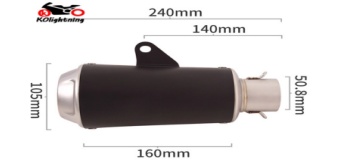
In the motorcycle industry, the motorcycle muffler is far more than a sound-reducing component. It plays a critical role in exhaust efficiency, thermal management, durability, and overall riding performance. As motorcycle engines evolve toward higher power density and stricter emission requirements, the engineering behind high-performance mufflers has become increasingly sophisticated.
From an industrial perspective, understanding how high-performance motorcycle mufflers are designed and manufactured helps factories, distributors, and system integrators make informed sourcing and specification decisions. At www.kolightning.com, we work with performance-oriented manufacturers who focus on engineering consistency, structural reliability, and long-term value rather than short-term visual appeal.
This article explores what defines a high-performance motorcycle muffler, how it works, and why quality design and manufacturing matter in industrial and export markets.
1. What Is a High-Performance Motorcycle Muffler?
A high-performance motorcycle muffler is designed to manage exhaust noise while maintaining efficient exhaust gas flow. Unlike basic mufflers that rely heavily on restriction to reduce sound, performance-oriented mufflers aim to balance acoustics, back pressure, and thermal stability.
Key objectives of a high-performance motorcycle muffler include:
Controlled noise attenuation without excessive restriction
Stable exhaust flow across RPM ranges
Resistance to heat, vibration, and corrosion
Long service life under demanding riding conditions
For industrial buyers, a high-performance muffler must deliver consistent results across large production volumes, not just perform well in isolated test conditions.
2. The Role of the Motorcycle Muffler in Exhaust Systems
The motorcycle muffler is the final and most visible stage of the exhaust system, but its function goes far beyond noise reduction. It plays a critical role in regulating how exhaust gases exit the engine, directly influencing engine efficiency, thermal stability, and overall riding performance.
When exhaust gases leave the combustion chamber, they travel through headers and mid-pipes before reaching the muffler. At this final stage, the muffler must manage pressure waves, temperature, and gas velocity. Poorly designed motorcycle mufflers often introduce unnecessary turbulence or excessive back pressure, which can restrict exhaust flow and negatively impact throttle response.
A well-engineered motorcycle muffler helps to:
Improve exhaust scavenging
By allowing exhaust gases to exit smoothly, the muffler supports efficient scavenging, helping fresh air-fuel mixtures enter the combustion chamber more effectively during valve overlap.
Stabilize exhaust pulse timing
Consistent internal geometry helps maintain predictable exhaust pulses, which is essential for smooth power delivery across the RPM range.
Support optimal torque delivery
Properly managed back pressure ensures that low- and mid-range torque is preserved rather than sacrificed for high-RPM output.
Reduce thermal stress on upstream components
Efficient exhaust flow lowers heat accumulation in headers and catalytic components, extending the service life of the entire exhaust system.
In performance motorcycles, even small inefficiencies in the muffler can have noticeable effects on ride quality, engine responsiveness, and long-term durability. For industrial buyers and OEM partners, muffler performance consistency is essential to avoid variability across production batches.
3. Internal Structure of High-Performance Mufflers
The internal configuration of a motorcycle muffler is the primary determinant of both sound characteristics and exhaust flow efficiency. While the external appearance may attract attention, it is the internal design that defines true performance.
Common Internal Muffler Designs
Muffler Design | Internal Structure | Performance Characteristics |
Straight-Through | Perforated core with packing | Maximum flow, aggressive tone |
Chambered | Multiple chambers and baffles | Balanced sound control |
Hybrid | Core + tuned chambers | Optimized power and noise balance |
Straight-through designs are commonly used in high-performance motorcycle mufflers because they minimize flow restriction. Exhaust gases pass through a perforated core surrounded by sound-absorbing packing materials, allowing for high flow rates and reduced turbulence.
Chambered designs, on the other hand, rely on internal baffles and chambers to redirect exhaust gases. While effective for noise reduction, excessive chambering can increase back pressure if not carefully engineered.
Hybrid designs combine elements of both systems, using a perforated core with strategically placed chambers. This approach allows manufacturers to fine-tune sound output while maintaining efficient gas flow, making hybrid mufflers popular where noise regulations and ride comfort must be balanced.
For industrial applications, internal consistency is critical. Variations in core alignment, packing density, or chamber geometry can lead to inconsistent acoustic output and uneven performance across production runs.
4. Materials Used in Motorcycle Mufflers
Material selection directly affects durability, weight, heat resistance, and long-term reliability. A high-performance motorcycle muffler must withstand continuous exposure to extreme temperatures, vibration, and environmental conditions.
Common Muffler Materials
Material | Advantages | Typical Use |
Stainless Steel | Corrosion resistance, strength | Street & performance motorcycles |
Titanium | Lightweight, excellent heat resistance | Premium performance systems |
Aluminum | Lightweight, cost-effective | Entry-level performance |
Carbon Fiber (outer shell) | Heat insulation, reduced weight | High-end exhaust housings |
From an industrial standpoint, stainless steel remains the most widely used material. It offers an optimal balance between corrosion resistance, mechanical strength, manufacturability, and cost control. Stainless steel mufflers also maintain structural stability under repeated heat cycles, which is essential for long-term use.
Titanium mufflers provide significant weight reduction and superior heat resistance, but higher raw material and processing costs limit their use to premium applications.
Aluminum is lightweight and economical but less tolerant of high temperatures, making it more suitable for outer shells rather than full exhaust flow paths.
Carbon fiber, when used as an outer sleeve, offers thermal insulation and weight reduction but does not directly handle exhaust gases.
5. Precision Manufacturing and Welding Quality
Even the best materials cannot compensate for poor manufacturing. Precision fabrication is a defining factor of motorcycle muffler quality, especially for systems intended for long-term use in performance and industrial markets.
High-quality motorcycle mufflers are typically produced using:
CNC pipe bending to maintain accurate flow geometry and prevent internal deformation
Automated or TIG welding for consistent, high-strength joints
Controlled heat input during welding to prevent warping and residual stress
Key Manufacturing Indicators of Quality
Uniform pipe bends without deformation
Smooth internal surfaces to reduce turbulence
Consistent wall thickness across components
Clean, continuous weld seams
Weld quality is particularly critical. Poor welds are often the first failure point in low-grade mufflers, leading to cracks, leaks, or fatigue under repeated thermal expansion and vibration. Inconsistent weld penetration or excessive heat input can weaken the surrounding material, shortening service life.
For industrial buyers, welding consistency directly impacts warranty performance, customer satisfaction, and brand reputation. Precision manufacturing ensures that each motorcycle muffler performs predictably, batch after batch, under real-world riding conditions.

6. Exhaust Flow Optimization and Performance Impact
What happens inside the muffler is just as important as its external appearance. Internal flow design determines how efficiently exhaust gases exit the engine.
Key Internal Components
Perforated core pipes
Collectors and flow transitions
Sound chambers or baffles
Packing materials (glass fiber, basalt fiber)
A high-performance motorcycle muffler is tuned to maintain adequate back pressure. Excessive restriction reduces power, while too little back pressure can negatively affect low-end torque and rideability.
Well-designed mufflers are often optimized for specific engine displacements and RPM ranges rather than relying on one-size-fits-all designs.
7. Acoustic Engineering and Sound Control
High-performance mufflers are not simply louder; they are acoustically engineered to deliver controlled, refined sound output.
Effective sound control focuses on:
Eliminating harsh high-frequency noise
Reducing resonance and droning
Maintaining a clean exhaust note under load
Packing materials play a critical role in absorbing unwanted frequencies while preserving performance characteristics.
8. Durability Under Heat and Vibration
Motorcycle mufflers operate under extreme conditions:
Continuous exposure to high temperatures
Constant vibration from engine and road input
Moisture, debris, and environmental exposure
High-performance mufflers are engineered to:
For export and industrial markets, durability directly affects warranty performance and long-term customer satisfaction.
9. Industrial Value of High-Performance Motorcycle Mufflers
From a factory and sourcing perspective, high-performance motorcycle mufflers offer several advantages:
Industrial Priority | Benefit |
Consistent quality | Reduced rejection and rework |
Durable construction | Lower warranty risk |
Standardized specs | Easier mass production |
Stable supply | Long-term cooperation |
Selecting properly engineered mufflers ensures predictable performance and brand credibility across global markets.
Conclusion
A high-performance motorcycle muffler is the result of careful engineering, precise manufacturing, and material expertise. It influences engine efficiency, sound quality, durability, and rider experience far beyond basic noise reduction.
At www.kolightning.com, we focus on motorcycle muffler solutions that meet the technical expectations of industrial buyers while delivering reliable performance in real-world conditions. If you are evaluating muffler designs for production, distribution, or performance applications, understanding these fundamentals is essential. We welcome you to connect with us to explore solutions tailored to modern motorcycle exhaust systems.
FAQ
What makes a motorcycle muffler high-performance?
A high-performance motorcycle muffler balances noise control with optimized exhaust flow, minimizing restriction while maintaining durability.
Do high-performance mufflers improve engine performance?
Yes. Properly designed mufflers can improve throttle response and exhaust efficiency when matched to the engine.
Are straight-through mufflers always better?
Not necessarily. While they offer excellent flow, hybrid designs may provide better torque balance and sound control for certain applications.
How long does a high-quality motorcycle muffler last?
With proper materials and manufacturing, high-performance mufflers can deliver long service life under normal riding conditions.