Upgrading the exhaust on the CFMOTO 675 is a high-priority modification for many riders. Riders want better performance, reduced weight, and a more aggressive exhaust note. However, hardware compatibility issues frequently derail the entire installation process. Buyers often purchase an aftermarket system based purely on aesthetics and sound clips. They only discover during installation that their factory O2 sensors do not mate with the new headers.
This common oversight leads to frustrating delays and unexpected expenses. A mismatched exhaust system triggers immediate dashboard errors and disrupts engine fueling. Our guide breaks down the structural differences in various sensor configurations. We will explain the technical implications of mismatched ports and how they impact performance. You will also learn a proven framework for evaluating the right exhaust system for your specific motorcycle. By following this guide, you can successfully modify your exhaust without triggering ECU errors or sacrificing engine reliability.
Key Takeaways
Before purchasing any aftermarket exhaust for the CFMOTO 675, you must physically verify your specific bike’s factory sensor configuration (regional models may vary).
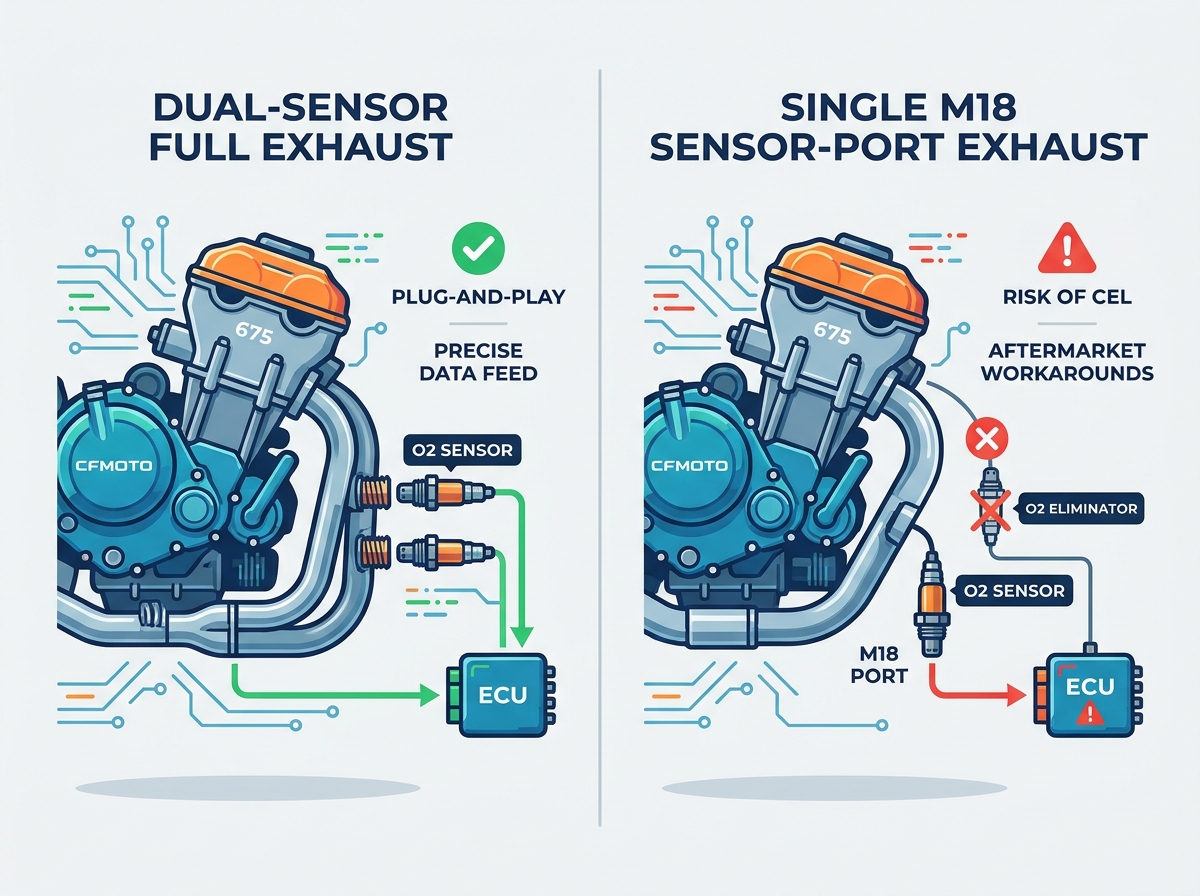
Upgrading to a CFMOTO 675 dual-sensor full exhaust requires precise hardware alignment to prevent check engine lights (CEL) and maintain optimal Air/Fuel Ratio (AFR) mapping.
Choosing a single M18 sensor-port exhaust option on a dual-sensor harness necessitates aftermarket workarounds (like O2 eliminators or custom tuning), which introduce secondary reliability and compliance risks.
Evaluating exhaust systems should prioritize ECU compatibility and fitment tolerances over unverified horsepower claims.
The Fitment Problem: Single and Dual O2 Sensor Layouts Explained
Upgrading the exhaust system on your motorcycle sounds like a straightforward mechanical task. You simply unbolt the old pipes, align the new headers, and tighten the mounting brackets. However, oxygen (O2) sensors present a major technical bottleneck. These small electronic probes measure unburned oxygen levels inside your exhaust stream. They transmit this vital data back to the engine control unit (ECU). The ECU then calculates and adjusts the fuel mixture in real time.
Factory exhaust configurations differ significantly depending on where you purchased the motorcycle. Stricter regional emissions standards force manufacturers to deploy highly complex sensor networks. Your specific CFMOTO 675 might feature a dual-sensor setup designed to monitor individual cylinders closely. Alternatively, bikes manufactured for less regulated environments might utilize a simpler, single-sensor arrangement.
This regional variation causes a massive disconnect within the aftermarket exhaust industry. Exhaust manufacturers frequently design generic piping templates to minimize their production costs. Many brands overlook the specific single and dual O2 sensor layouts required for seamless electrical integration. They assume a one-size-fits-all approach will satisfy mostly everyone.
Getting this fitment wrong carries a steep penalty. You might complete a difficult installation only to find a native sensor dangling without a home. You then face erratic engine idling and poor throttle response. Unmonitored exhaust gases trick your ECU into running the engine far too rich or dangerously lean. You end up wasting time dismantling the new system, processing returns, or hunting down emergency thread adapters.
Evaluating the CFMOTO 675 Dual-Sensor Full Exhaust
A direct replacement exhaust system effectively eliminates major electrical installation headaches. If your motorcycle originally featured two O2 sensors, you need an aftermarket system designed specifically for that architecture. We classify this direct match as a true dual-sensor compatible setup. It represents the safest path for recreational riders.
Securing a reliable CFMOTO 675 dual-sensor full exhaust requires strict attention to precise hardware details. You must look for exact-match O2 bungs welded onto the header pipes. These threaded ports must feature the correct thread pitch and precise angle placements. The outcome is highly beneficial for home mechanics. You enjoy a true plug-and-play installation. You simply reinstall your factory sensors without stretching fragile wires or modifying the main electrical harness.
Retaining both sensors perfectly balances peak performance and engine accuracy. Dual sensors feed highly precise, localized data continuously to the ECU. The computer manages the fuel trims across different cylinders independently based on this feedback. This constant communication makes true dual-sensor exhausts structurally superior for un-tuned, purely bolt-on applications. The ECU maintains safe operating parameters because it receives accurate, real-time exhaust reporting.
However, we advise you to remain deeply skeptical of vague aftermarket marketing claims. Many exhaust brands advertise "universal dual fitment" merely to capture broader online sales. They rarely specify the exact thread pitch dimensions in their descriptions. CFMOTO factory sensors typically use M12 or M18 threads. If the aftermarket bung does not match your factory sensor threads exactly, the exhaust will simply not fit. Always confirm the actual thread measurements prior to processing your payment.
Navigating the Single M18 Sensor-Port Exhaust Option
Sometimes, tracking down a direct-fit dual system proves incredibly difficult. Many high-end racing brands and budget exhaust manufacturers only produce a single M18 sensor-port exhaust option. This scenario represents a deliberate compromise rather than a flawless direct replacement. Choosing this route forces you to alter how the motorcycle manages its onboard fuel mapping logic.
Implementation risks emerge immediately during the installation process. You must ask what happens when you install a single-sensor exhaust onto a dual-sensor motorcycle network. You are inevitably left holding a live, permanently disconnected O2 sensor. Leaving it unplugged will trigger an immediate check engine light (CEL) on your digital dash display.
Many riders attempt to solve this using O2 sensor eliminators or tuning dongles. You physically plug these small electronic resistors into the wiring harness in place of the missing exhaust sensor. They send a fixed voltage signal back to the ECU. This effectively tricks the onboard computer into believing the sensor is functioning normally and running perfectly clean.
Unfortunately, eliminator dongles are never a perfect long-term fix. They force the ECU into a strict open-loop default state. The computer completely stops making active fuel adjustments based on real unburned oxygen readings. It relies entirely on static factory fuel maps programmed long ago. You risk running a localized rich or lean mixture inside the cylinders. This degrades throttle response and slowly increases internal engine temperatures over time.
When does this single-port compromise actually make logical sense? We recommend it strictly for dedicated track-use motorcycles. It also works well for riders simultaneously committing to a full custom ECU flash. During a professional flash, a tuner completely disables the stock closed-loop O2 feedback inside the software, rendering the physical sensors obsolete.
Pre-Purchase Decision Framework: Hardware and Tuning Reality
Selecting the right exhaust requires a structured, logical evaluation process. You cannot rely solely on aggressive styling or impressive sound clips. Use the following structured checklist to shortlist your top exhaust system candidates efficiently and avoid buyer's remorse.
Physical Fitment Clearances: Verify the header pipe angles visually. The pipes must clear the lower plastic fairings completely. The sensor bungs must angle outward, away from the engine block. Incorrect angles cause the fragile sensor bodies to strike the hot engine casing during normal vibration.
Material Selection and Expansion: Exhaust pipes endure extreme thermal stress daily. You must evaluate how different metals react to constant, intense heat cycling. This expansion directly affects the integrity of the O2 bung welds over several riding seasons.
Strict ECU Requirements: Separate your shopping options clearly. Identify which exhausts function safely as simple "bolt-on" upgrades utilizing factory sensors. Contrast them against specialized systems demanding mandatory fuel mapping or expensive ECU flashes to run safely.
Material Properties Comparison
Material Type
Heat Retention
Weld Durability (O2 Bungs)
Weight Characteristics
Stainless Steel
Moderate. Radiates heat steadily.
High durability. Excellent resistance to cracking under vibration.
Heavier, but offers robust structural longevity.
Titanium
Low. Dissipates heat incredibly fast.
Prone to stress fractures if welded poorly near sensor bungs.
Finally, you must conduct a thorough trust and evidence check. Never blindly trust generic product page renders or 3D CAD models. These digital images often omit crucial mounting details and sensor ports entirely. Encourage the seller or manufacturer to send actual, unedited photos of the header pipes. Explicitly ask them to show the O2 bung placements on the physical product. Demanding hard physical evidence prevents frustrating returns later.
Implementation Considerations and Rollout Risks
Swapping your motorcycle exhaust system requires patience, a clean workspace, and proper mechanical technique. Mishandling the delicate electronic sensors can cause expensive electrical damage quickly. Follow these precise installation best practices to ensure a smooth, error-free upgrade process in your garage.
Apply anti-seize compound properly. Place a tiny amount of high-temp anti-seize on the O2 sensor threads prior to installation. You must keep this messy compound far away from the delicate sensor tip. Contaminating the probe permanently ruins its ability to read exhaust gases accurately.
Observe proper torque specifications. Tighten the sensor firmly using a dedicated wrench, but do not overtighten it. Excessive force easily strips the soft metal threads hidden inside the exhaust bung, ruining the header pipe.
Route the sensor wires carefully. New aftermarket headers frequently radiate more heat than heavy factory pipes. Tie the wiring harness back securely using heat-resistant zip ties. Keep all cables far away from direct contact with hot metal surfaces to prevent severe electrical melting.
We must also address the realities regarding legal compliance and powertrain warranties. Modifying the exhaust deeply impacts your legal standing as a rider. Removing the factory catalytic converter and altering the closed-loop sensor system typically violates strict local emissions laws. Dealerships also closely scrutinize powertrain warranties after major mechanical modifications occur. If an engine failure happens, a modified exhaust and tampered sensor loop gives the manufacturer valid grounds to deny your warranty claim entirely.
Conclusion
Choosing the right aftermarket exhaust for your CFMOTO 675 requires careful technical consideration. You must navigate beyond flashy marketing and prioritize hardware compatibility first. Your decision logic should always start by verifying sensor compatibility to prevent frustrating dashboard errors. Once you confirm the hardware matches, you can evaluate your tuning budget and willingness to flash the ECU. Only after addressing these technical hurdles should you base your final decision on sound and aesthetics.
Take immediate action before completing your online purchase. Go directly to your motorcycle and physically trace the exhaust headers with a flashlight. Count the exact number of O2 sensors currently installed on the factory pipes. Note the wire lengths and the thread sizes. Armed with this physical data, you can confidently click "buy" knowing your new exhaust system will fit perfectly.
FAQ
Q: Will a single-sensor exhaust throw a Check Engine Light on a dual-sensor CFMOTO 675?
A: Yes. In most cases, leaving an O2 plug completely disconnected will immediately trigger a check engine light. The ECU recognizes the missing data instantly. Riders often use O2 eliminator plugs to bypass the system. However, these dongles serve as temporary or track-only solutions. They force the bike into an open-loop state, bypassing dynamic fuel adjustments.
Q: Do I need a tune if I install a dual-sensor full exhaust?
A: Retaining both sensors helps the factory ECU adjust fuel trims within narrow, safe margins. However, removing the factory catalytic converter changes exhaust scavenging drastically. The engine breathes much differently. We highly recommend an ECU tune for long-term engine longevity and smooth throttle response, even if no check engine light is present.
Q: Can I use thread adapters to make factory sensors fit a larger M18 bung?
A: Yes, M18 to M12 step-down thread adapters exist and function mechanically. However, they physically alter the depth at which the sensor probe sits inside the active exhaust stream. This depth change can slightly skew the Air/Fuel Ratio readings sent to the ECU. We always prefer direct-fit bungs welded to the correct specification.